

Sharper worlds and a deeper sky
Planets and the sky are painted at much higher resolution, and both follow real astronomy more closely, from rivers and seasons to nebula gases and deep-field galaxies.
The last few days went into the two things you look at most in a star system: the worlds, and the sky behind them. Both are a lot sharper now, and both are closer to the real thing.
Sharper worlds
Options › Graphics › Planet detail sets how big each world is painted. The world you’re looking at is 4096 pixels wide on High, the default, and 8192 on Max. Low and Standard are there for smaller graphics cards.
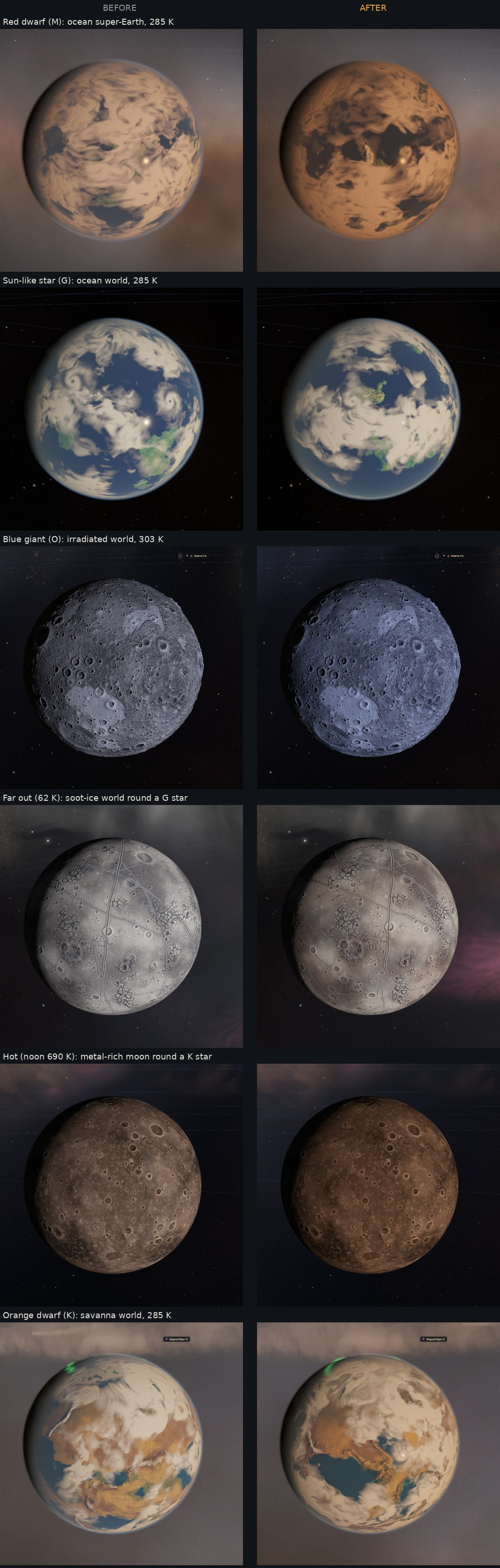
Fly close to a rocky world and the coastlines stay crisp. The finest detail is drawn fresh for every pixel on your screen, so forest thinning into grassland breaks up into patches instead of a soft blur. Plains are smoother, so hills and mountains stand out, and mountains run in long ranges with foothills and the odd high plateau.
Land that works like land
Rivers start in the hills and run downhill, joining as they go, until they reach the sea. The big ones fan out into deltas. Lakes fill the hollows, fresh where it rains and white salt pans where it doesn’t.
Mountains have a tree line, with bare rock and meadow above it. Glaciers creep down high valleys. Deserts have dune seas lined up across the wind, and the hearts of big continents dry out. Warm shallow seas have reefs.
Tilted worlds have seasons. The snow line creeps toward the equator in winter and draws back in summer, seas freeze later and break up into floes, and a world tipped far over freezes a whole hemisphere.
Worlds that follow their star
Every world now takes its look from how hot it really is. Close to its star, bare rock is baked dark and cracked, and the hottest glow dull red at night. Far out, frost settles in cold hollows and old ice turns red-brown.
Seas of methane, ammonia or acid stay liquid at their own temperatures, so a methane world shows dark seas instead of being frozen over. Starlight takes its star’s color too: a red dwarf’s worlds are lit a dim warm orange, a blue giant’s a cold blue-white.
Giants and moons
Gas and ice giants look like their temperature, from soft hazy cold giants to hot ones that darken and glow faintly. Their bands have weather: waves curling where two bands slide past each other, dark plumes and small brown storms. Some have a hexagon round the pole or a ring of cyclones.
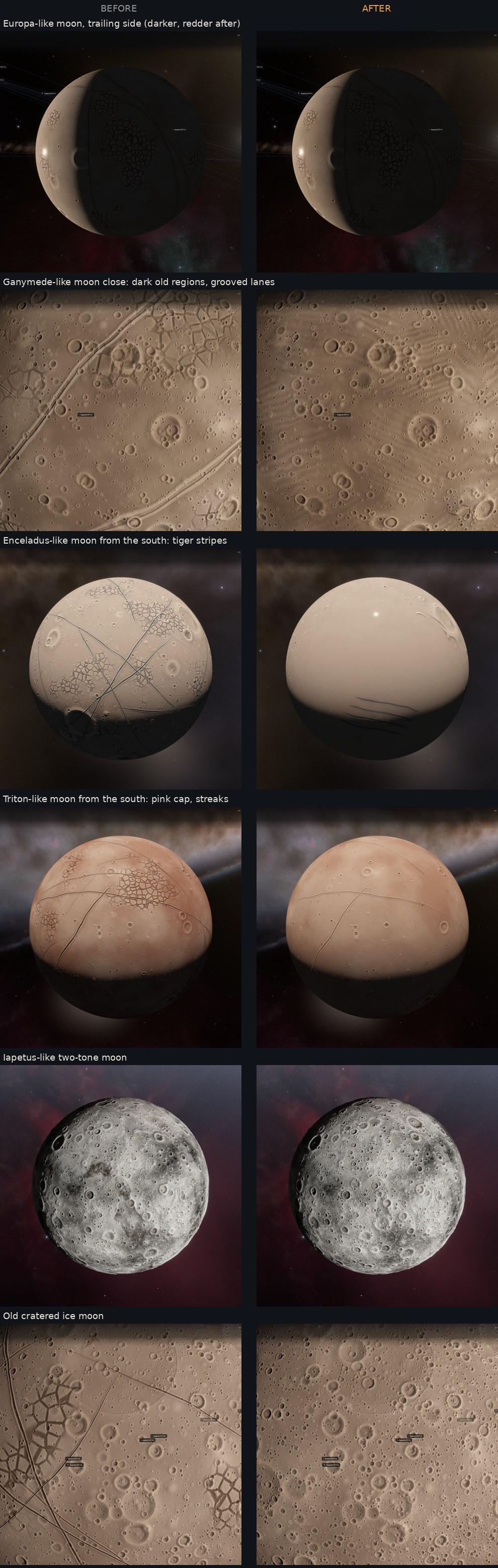
Icy moons are no longer all cracked the same way. Some have bright grooved lanes, some are fresh white with stripes at the south pole, some are pink and dimpled, and old ones are just covered in craters.
In the Solar System, Saturn has its hexagon, Jupiter its Great Red Spot and polar cyclones, and the Moon shows its dark seas on the side facing Earth.
A deeper sky
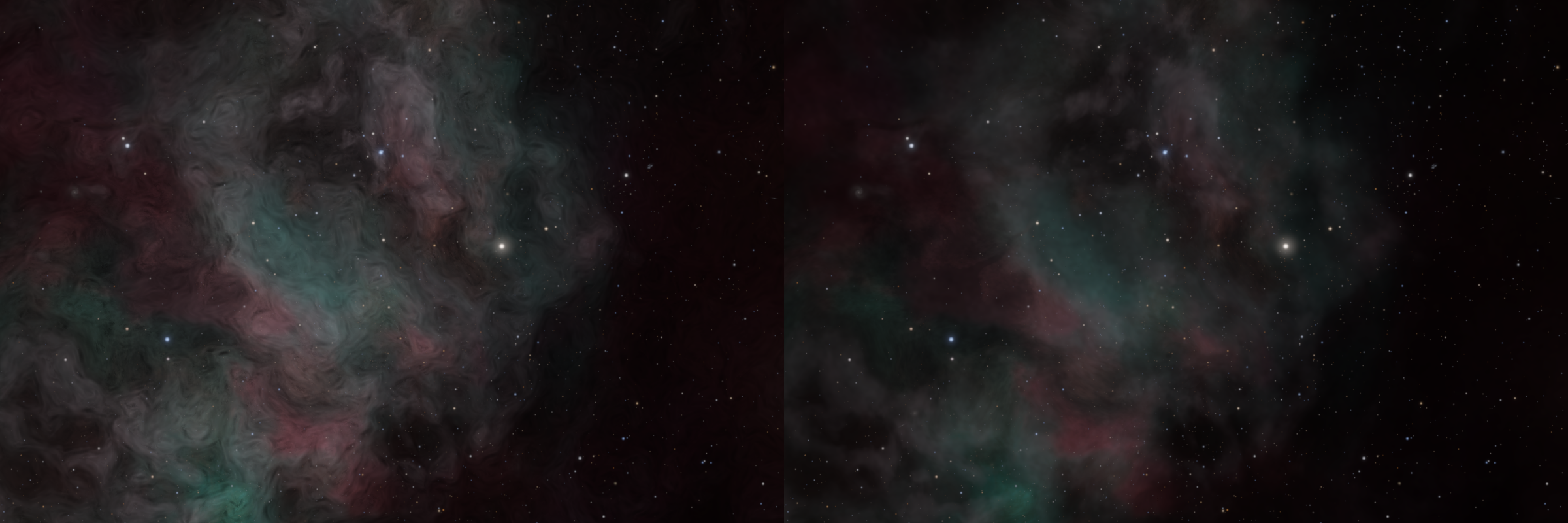
Options › Graphics › Sky detail does the same for the background. The nebulas and your galaxy’s band are painted at 8192 by 4096 on High and 16384 by 8192 on Max. High uses about 512 MB of video memory inside a star system and Max about 2 GB. On High and Max the fine strands of gas in each nebula are drawn live for every pixel, so they stay sharp however close you look.
The other galaxies in your sky are sharper too, and smaller, so they read as far away. Behind them sit thousands of tiny faint galaxies, like a deep-field telescope photo.
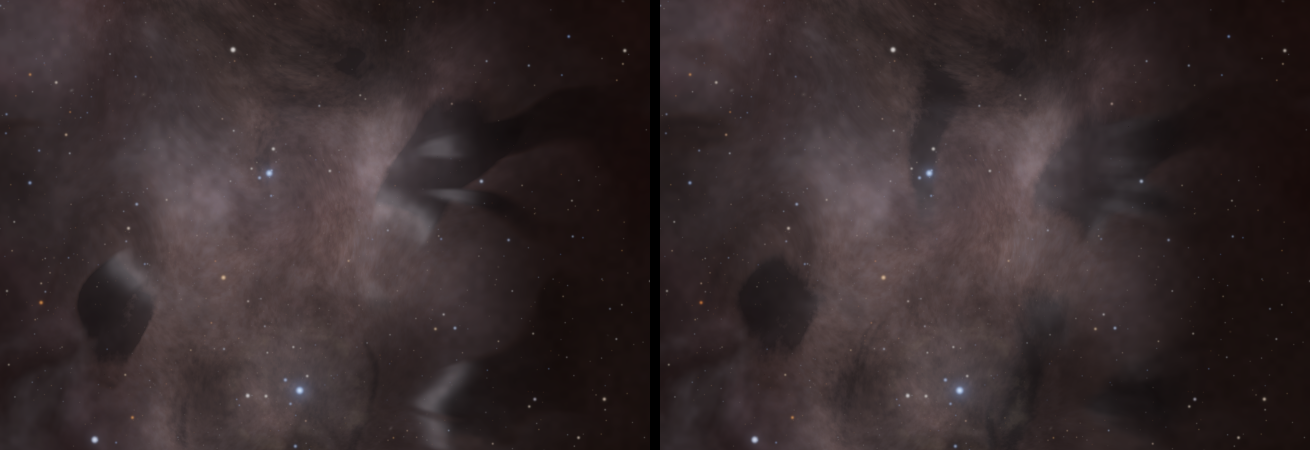
Nebulas show the gases real ones are made of: teal oxygen near their young stars, darker red sulfur at the edges, blue haze where dust reflects a bright star. Their dark pillars thicken from wispy edges instead of looking cut out. Most skies have a few dense star clouds crossed by dark dust lanes.
The background stars have the colors a camera records for their temperature, with fewer bright ones and more faint ones, as in a real sky. Nothing twinkles.
When the sky changes, switching galaxy or loading a game, the new one now fades in. It never pops.